Why Is Choosing the Right Flowmeter Important?
Selecting a flowmeter involves more than matching the instrument to a pipe diameter. The correct choice depends on the fluid being measured, the process conditions, the required measurement output, and the purpose of the measurement.
A suitable flowmeter can support process monitoring, improve visibility into consumption, and provide the measurements needed for control and operational decisions. A poorly matched instrument may give unreliable readings or require unnecessary maintenance.
1. Identify the Fluid Being Measured
Start by identifying whether the process involves a liquid, gas, steam, or slurry. Record relevant properties such as conductivity, viscosity, density, solids content, bubbles, and chemical compatibility.
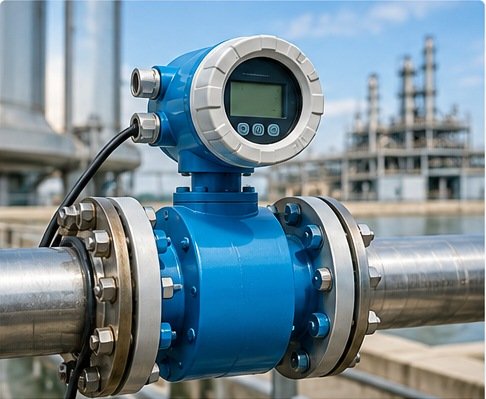
For example, electromagnetic flowmeters require electrically conductive liquids, while thermal mass flowmeters are commonly selected for gas mass-flow applications.
2. Confirm the Required Flow Range
Provide the minimum, normal, and maximum expected flow rates. A meter should be sized for the actual operating range rather than selected on pipe size alone.
Also identify whether you need volumetric flow, mass flow, totalized volume, batch measurement, or another process variable.
3. Check Pipe Size and Installation Conditions
Record the pipe diameter, material, wall thickness, orientation, and available straight-pipe length. Note nearby elbows, valves, pumps, reducers, and other features that could affect the flow profile.
For some applications, an inline meter is appropriate. In others, an insertion or clamp-on design may simplify installation.
4. Confirm Temperature and Pressure
Every meter has specified operating limits. Check both normal and extreme conditions, including possible temperature or pressure changes during startup, cleaning, or process shutdown.
For corrosive, abrasive, hygienic, or hazardous applications, confirm the required wetted materials, seals, enclosure protection, and relevant approvals.
5. Choose a Suitable Measurement Technology
| Flowmeter type | Typical applications |
|---|---|
| Electromagnetic | Conductive liquids, water, wastewater and suitable chemical services |
| Ultrasonic | Suitable liquid or gas applications, including clamp-on measurement where supported |
| Vortex | Steam, gases and selected liquid applications |
| Coriolis | Direct mass-flow measurement and, on suitable models, density measurement |
| Turbine | Many clean, relatively low-viscosity liquid or gas applications, depending on design |
| Thermal mass | Gas mass-flow measurement |
| Rotameter | Local indication of flow in suitable liquid or gas services |
| Differential pressure | Flow measurement using a primary element and pressure differential |
These are general application guides, not universal rules. The correct instrument depends on the exact fluid, process limits, installation, and performance requirements. KEYENCE America+1
6. Confirm Outputs and Communication
Decide how the flowmeter will connect to your system. Requirements may include a local display, 4–20 mA output, pulse output, HART, Modbus, or another supported communication protocol.
Check the power supply, signal compatibility, installation environment, calibration requirements, and maintenance access before finalizing the model.
Find the Right Flowmeter with Accurate Flowmeters
You do not need to identify every technical specification before making an enquiry. Start with the information you have: fluid name, flow range, pipe size, operating temperature, pressure, and application.
Accurate Flowmeters can use these details to help narrow down suitable options for your process and prepare a quotation based on your requirements.